
Cricket betting on Laser247 runs through an exchange, not a bookmaker. You back a market when you think it will land, lay against it when you think the favourite is wrong, and trade in and out of positions while the match is still being played. The odds you see are set by other players in the market, not by a margin desk, which is why a fixture worth ₹0 of edge at a sportsbook can still pay you on Laser247.
Below: how to place your first bet, the markets you’ll see, IPL and international coverage, fancy and session bets explained plainly, live betting, and four strategies that suit an exchange.
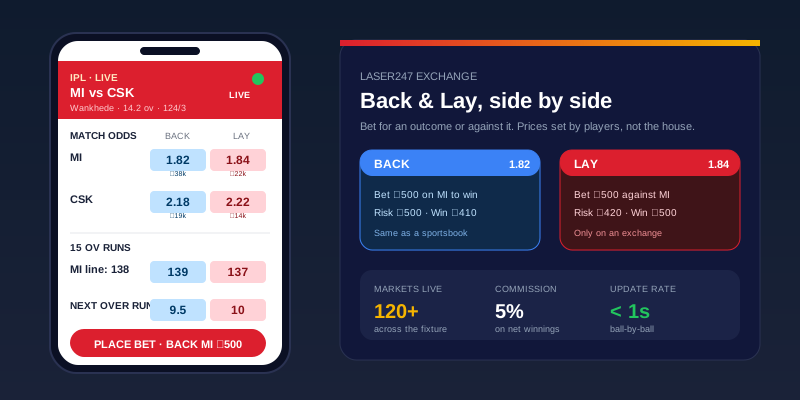
Place Your First Cricket Bet on Laser247
The first cricket betting session on Laser247 takes longer than the second one, because most of the time goes into looking around. The actual mechanics of placing a bet are short, and they barely change between markets.
Get your ID first. Funded cricket bets need a real account, not a demo. The five-minute WhatsApp signup walkthrough lives on the Laser247 ID page if you have not done it yet, and the same WhatsApp agent that creates the account also handles the deposit instructions when you reach that step.
Fund the wallet. UPI, PhonePe, Paytm, Google Pay, AstroPay, and direct bank transfer all work. The Deposit and Withdrawal Guide covers minimum amounts, processing times, and the screens to expect on each method. One funded wallet handles every cricket market on the platform.
Pick a fixture you actually follow. A cricket exchange rewards knowledge of the players, the conditions, and the format. The fixture list is sorted by start time and tournament, so an IPL match jumps out within seconds of opening the cricket section. Avoid your first real bet being on a county T20 you have never watched.
Choose your side. Every market on the page shows a back price on the left and a lay price on the right. Backing means you win if the outcome happens. Laying means you win if it does not. Two clicks and you have a position open.
Set your stake and confirm. Type the amount, check the potential profit and liability the slip shows you, and confirm. The position appears in your open bets, alongside a running profit or loss column that updates with the market. From the moment you confirm, you can also close the position by laying back what you backed — that is trading, and it is the part of cricket betting that does not exist at a sportsbook.
The Cricket Markets You’ll Actually See
A typical IPL fixture on Laser247 carries dozens of markets, and a Test match running over five days carries hundreds across the innings. The ones you will see most often, with what they actually mean.
- Match Odds. Who wins the match. The headline market and the one with the deepest liquidity, which means the prices stay tight even with large stakes on either side.
- Tied Match. A separate market on the rare scenario of a tied result. Specific to limited-overs cricket and useful as a small hedge in low-scoring chases.
- Top Batsman / Top Bowler. Which player scores the most runs or takes the most wickets in a given innings or match. Player-led markets price quickly off team news and toss results.
- Innings Total Runs. Over/under on the first or second innings total. The pricing reflects pitch reports, weather, and the chasing or setting side’s recent form.
- Fall of Next Wicket. Runs scored before the next wicket falls. A short-duration market that often opens and closes inside ten overs.
- Session and Bracket Runs. Runs scored across a defined block of overs — usually the first six, the next ten, and the death overs. These markets are central to the way Indian cricket betting prices an innings, and they get their own section below.
- Fancy Markets. A loose category covering anything that is not a result market. Boundary counts, dot ball counts, individual player totals, and method-of-dismissal lines all sit here.
- Tournament Outright. Who wins the tournament. Live across the full season and reprices after every match.
Cover the IPL on Laser247
The Indian Premier League carries the deepest cricket markets on Laser247 by a wide margin. Twenty-plus fixtures every week from late March to late May, two playoff rounds, and a final that prices for weeks before the toss. ESPNcricinfo’s IPL records hub is the cleanest single-source reference for tournament history, and the patterns it shows up — short boundaries, high-scoring grounds, toss-driven outcomes at certain venues — feed directly into how the exchange prices each fixture.
The IPL window opens with auction-week trading on outright markets. Player movement reprices the title odds inside hours of an auction closing, and the early-season match odds carry more uncertainty than they will once the table starts to settle. The first two weeks reward patience; the last two reward conviction.
Inside a fixture, the markets you will lean on most are the match odds, the powerplay session runs, the top batsman in each innings, and the next-wicket bracket. The powerplay (overs 1 to 6) is the highest-liquidity session market in IPL cricket, because the pricing is short, the data is fresh, and the swing potential on each ball is high. Death overs (16 to 20) come second.
The IPL fixture list also creates trading patterns that do not exist in other leagues. Back-to-back double headers in the second half of the season mean some teams play three matches inside five days, with travel between them. That fatigue prices in. Squads with deeper benches gain a quiet edge that the outright market sometimes lags on. If a team has fixtures stacked against a strong opposition in the final week, their playoff odds can be a few prices long of where they should be.
The IPL is also the only tournament where casual interest meets exchange depth. Every market has volume because every match has eyes — which is what makes the IPL a good place to learn an exchange, not just to bet one.
Fancy and Session Bets, Explained Plainly
Two of the most-searched terms in Indian cricket betting both refer to market types that do not exist at a Western sportsbook. They are not exotic, they are not hidden, and they are not harder than match odds — they just go uncovered most places.
Session bets
A session bet is a runs over/under on a defined block of overs. The most common blocks in T20 cricket are overs 1–6 (powerplay), overs 7–15 (middle), and overs 16–20 (death). In ODI cricket the blocks are longer — typically 1–10, 11–25, 26–40, and 41–50. The line moves every ball. If the line is 52 and the team is 48 for 1 after five overs, the next legal ball alone can push you above or below the line.
You do not bet on whether the line is correct at the start of the session. You bet on the closing total at the end of the block, with the line adjusting until the last ball of the session is bowled.
Fancy bets
Fancy is a catch-all for in-game markets that are not the result. Boundary counts in an innings, dot balls in the powerplay, a specific batsman to reach 30, lambi (long) totals across multi-over groupings, or method of dismissal on the next wicket. The label is informal, but the structure is consistent: a single in-game event with a yes/no or over/under line, settled within the match.
Fancy markets are how an exchange handles the questions a sportsbook never asks. “Will the next wicket be caught or bowled” is a fancy. “How many sixes in overs 16–20” is a fancy.
How session pricing actually moves
Session lines are priced by current run rate, balls remaining, and the wickets in hand, with adjustments for the bowling team’s death-overs strength. A team at 30 for 0 after 4 overs is on track for 45 runs in the powerplay, and the line will sit just below that. As the over count climbs and the data thins, the line stabilises — which is why early-session entries are more volatile than late ones.
International Cricket Beyond the IPL
Cricket on Laser247 does not stop at the IPL. The international and franchise calendar runs almost year-round, and every major fixture appears in the exchange list with full back-and-lay depth.
| Tournament | Window | Markets Depth | Notable Markets |
|---|---|---|---|
| ICC T20 World Cup | Biennial (Feb–Mar or May–Jun) | Deepest outside the IPL | Outright, group winner, top batsman/bowler, player of the tournament |
| ICC ODI World Cup | Every four years | Very deep across the full event | Outright, host advantage, semi-final progression |
| BBL (Big Bash) | Dec–Jan | Deep on match odds, lighter on player markets | Match odds, powerplay session, top batsman |
| PSL (Pakistan) | Feb–Mar | Solid match odds, moderate player depth | Match odds, top wicket-taker, finals progression |
| CPL (Caribbean) | Aug–Sep | Match odds with steady volume | Match odds, top run-scorer, outright |
| Bilateral India series | Year-round | Deepest on India fixtures | Series odds, match odds, full fancy menu |
| Ranji Trophy | Oct–Mar (domestic India) | Lighter, match-odds focus | Match odds, first-innings lead |
| WPL (Women’s IPL) | Feb–Mar | Growing, IPL-style coverage | Match odds, top batsman, outright |
The depth column matters more than the tournament prestige. A bilateral India ODI carries more market liquidity than a CPL semi-final, because the volume sits where the Indian audience is watching. Trade where the depth is, not where the trophy is biggest.
Bet Live While the Ball Is in Play
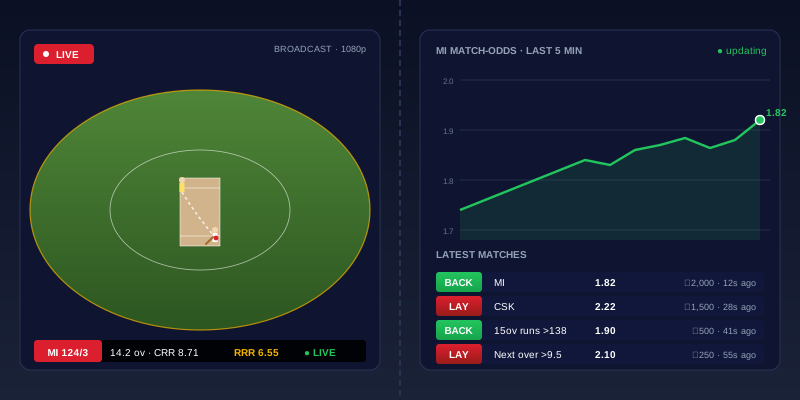
Live cricket betting is the part of the exchange that a fixed-odds account simply cannot replicate. Odds move every ball. A wicket repositions the match-odds market by 20% in three seconds. A six in the death overs flips the session line before the umpire signals the boundary.
Three things matter when you bet live. The first is connection speed — a half-second lag on a refreshing screen costs real money when the price changes on the very next ball. The Laser247 App on Android handles this better than a mobile browser, because it holds an open data connection and refreshes prices without re-rendering the page.
The second is bet placement speed. Live markets settle bets in milliseconds, but the order has to arrive at the exchange while the price is still showing. A bet placed three seconds after a wicket falls is no longer the same bet — the price has already moved, the market has already adjusted, and the slip will either reject or fill at the new number.
The third is knowing when to leave a position alone. Live betting rewards selective intervention — a position taken at a clear inflection point, held through the noise, and closed at the next inflection. Trading every ball is a way to bleed money on commission, even when individual calls are right.
Four Cricket Strategies That Suit an Exchange
A sportsbook gives you one option on each market: take the price or walk away. An exchange gives you four: back, lay, trade, and hedge. The strategies below use that wider toolkit on cricket specifically.
Lay the favourite when the toss matters more than form
On grounds where the toss decides 60% of recent results, the pre-match favourite is priced on form and the toss has not happened yet. Backing the underdog is hard because the price may still be too short — but laying the favourite at a slight discount, in a market where the toss has historically been the deciding factor, has a structural edge. The toss happens 30 minutes before play. The price adjusts within seconds. The window to act is short.
Trade the powerplay
The powerplay session market is the most-traded line in T20 cricket. If you have a read on whether a side prefers attacking openers or a watchful start, you can enter the session line in the first ball and exit it inside three overs once the pattern is clear. You are not betting on the final total. You are betting on how the market will price the final total once it has more information than it has now. That is trading, and the powerplay is where it works most cleanly.
Back the draw under weather pressure (Tests)
A Test match with significant time lost to rain trends toward a draw, but the draw market often takes hours to price that in. If the forecast shows rain on day 4 and day 5, and the match is balanced, the draw price can sit longer than it should for half a session before it adjusts. Backing the draw early in those conditions has historically been one of the cleanest exchange-only plays in Test cricket.
Hedge before the death overs
If you have a back position on a chasing team and they reach the death overs needing 50 from 30 balls with wickets in hand, your match-odds back has appreciated dramatically. You can either ride it to the result, or lay back a portion of the position at the new shorter price and lock in a guaranteed profit regardless of how the last four overs play out. That is hedging — and it is what makes the exchange more conservative than a sportsbook for anyone who actually uses it.
Why Cricket Betting Differs on Laser247
The difference between a sportsbook and an exchange is not just back versus lay. It is who you are betting against, what the price actually reflects, and what you can do with the position after you have placed it. The full mechanics live on the How Laser247 Exchange Works page, but the cricket-specific implications fit into one table.
| Dimension | Sportsbook | Laser247 Exchange |
|---|---|---|
| Price source | Bookmaker margin baked in | Set by other players, margin only from commission |
| Direction | Back only | Back and lay, on every market |
| After placement | Bet locked until settled | Tradeable until the market closes |
| Fancy and session markets | Rarely offered | Full menu on every fixture |
The exchange model rewards knowledge of the specific cricket scenario more than it rewards being right about who wins. A sportsbook bettor with a slight match-odds edge gets eaten by the margin. An exchange bettor with the same edge gets paid the actual probability difference. On cricket, where line movements between toss and first ball alone can be substantial, that difference adds up across a season.
Read the Match Before You Read the Odds
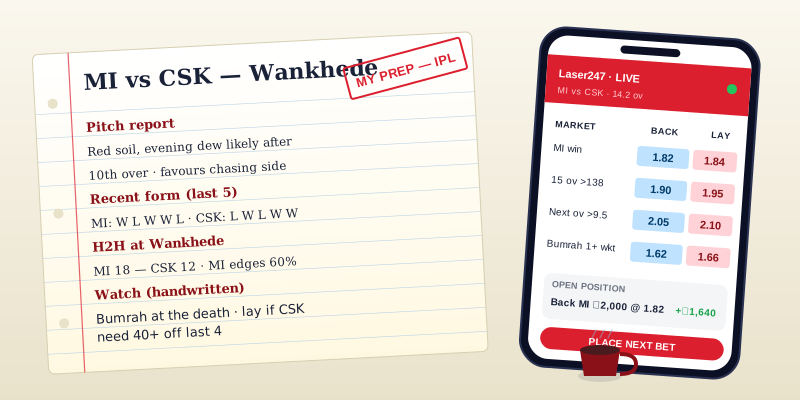
The exchange will give you the price. Reading the match is what tells you whether to take it. The short list of inputs that price every cricket market.
- Pitch report. Bowler-friendly or batter-friendly, dewy or dry, spin assistance or not.
- Toss outcome. Decides batting first or chasing — and on some grounds, that decides the match.
- Team news. Late changes to the XI, injury news, and rest rotations move player markets in seconds.
- Recent form. Three matches back, not three months back.
- Weather and D-L scenarios. Rain interruptions change the match length, the required rate, and every session line on the page.
Cricbuzz carries pitch reports, toss confirmations, and ball-by-ball updates for every fixture covered on the exchange. Keep it open in a second tab — the gap between a match update arriving on Cricbuzz and the exchange price adjusting is usually where the day’s edge sits.
FAQ
Can I bet on every IPL match through Laser247?
Yes. Every league-stage fixture, both qualifiers, the eliminator, and the final all appear on the exchange with full match-odds depth, session markets, and player markets. Coverage opens roughly an hour before the toss and stays live until the result is confirmed.
What is a fancy bet in cricket?
A fancy bet is a market on a specific in-game event that is not the match result. Boundary counts in an innings, dot balls in the powerplay, an individual batsman reaching a milestone, or the method of the next dismissal are all fancy markets. They settle within the match and run alongside the standard match odds.
What is a session bet?
A session bet is an over/under on runs scored across a defined block of overs. In T20 the blocks are usually the powerplay (1–6), middle (7–15), and death (16–20). In ODI cricket the blocks run longer. The line updates ball by ball until the session closes.
Are women’s cricket matches covered?
Yes. The Women’s IPL (WPL), women’s T20 and ODI World Cups, and major bilateral series all carry exchange markets. Depth is lighter than the men’s IPL but covers match odds, top run-scorer, and key player markets.
Can I bet on a match that has already started?
Yes. Live betting is one of the core reasons cricket sits well on an exchange. Match odds, session lines, and most fancy markets stay open until the moment they settle. The app is faster than a mobile browser for live cricket betting because it refreshes prices without re-rendering the page.
Does Laser247 cover domestic Indian cricket?
Yes, including Ranji Trophy, Vijay Hazare Trophy, and Syed Mushtaq Ali Trophy. Depth is lighter than IPL fixtures, with the focus on match odds and first-innings lead markets rather than the full fancy menu.
Can I cash out before the cricket match ends?
The exchange model lets you lay back what you backed, which is functionally the same as cashing out — the difference is you set the exit price yourself rather than accepting whatever the operator offers. If the price you want is in the market, you can take it.
What happens if a cricket match is abandoned?
Match-odds bets are voided and stakes refunded if no result is declared. Session and fancy bets that have already completed before abandonment usually stand. The exact settlement rule depends on the market and is shown in the market description before you place the bet.
Does the toss affect cricket betting markets on Laser247?
Significantly. Match-odds prices reprice within seconds of the toss being announced, often by 5% or more depending on the ground. Players who follow tosses live can take entry positions before the broader market has fully adjusted.